July 4, 2026
The Lost Art of Saying “I Don’t Know”
The ultimate irony of the AI era is that while software is getting better at pretending to be human, human candidates are destroying their competitive edge by trying to act like software.
When I was sixteen years old, having just cleared my Class 10th exams, I found myself facing one of the most intimidating milestones of my young life: trying to secure admission for Class 11th at Delhi Public School (DPS)—one of the most prestigious schools around.
The reputation of the interview panel preceded itself. The principal was notoriously strict, the competition was fierce, and the entire panel conducted the interview strictly in English. Coming from a small town, my English was far from fluent. I was terrified.
Seeing my anxiety, a senior neighbor who was like an older brother to me stepped in to help me prepare. We practiced interview etiquette, how to sit, and how to handle tough academic questions. But amidst all the drills, he taught me one specific lesson that completely transformed my perspective—a lesson that has stayed with me to this day.
He looked at me and said, "Shashank, if they ask you a question and you genuinely do not know the answer, do not freeze, do not panic, and definitely do not guess. Look them in the eye and say politely: 'Sorry sir, I do not know the answer to this right now.'"
It was a revelation. Up until that point, I thought an interview was a strict test of absolute correctness—a game where you had to be a walking encyclopedia. He showed me that nobody expects a sixteen-year-old to know everything. An interview isn't just a knowledge check; it is a holistic test of your personality, your character, and how you handle vulnerability and ambiguity under pressure.
That lesson became the bedrock of how I approached every interview in my career.
Today, the tables have turned. I sit on the other side of the interview desk, assessing candidates for engineering roles. And as I look at the current landscape, I am deeply concerned. The foundational lesson I learned years ago is completely evaporating, replaced by a dangerous new trend driven by generative AI.
The Encyclopedia Trap: Becoming Like the Machine
When we open tools like ChatGPT or Gemini and ask them a question, they almost always spit back an answer. Unless you are asking for instructions on something illegal or dangerous, these large language models will confidently generate paragraphs of text. They are built on massive training datasets, designed to never leave a prompt blank. They literally do not know how to say, "I don't know."
The tragedy of the modern interview process is that by using AI to cheat in real-time, human candidates are absorbing the exact same behavior.
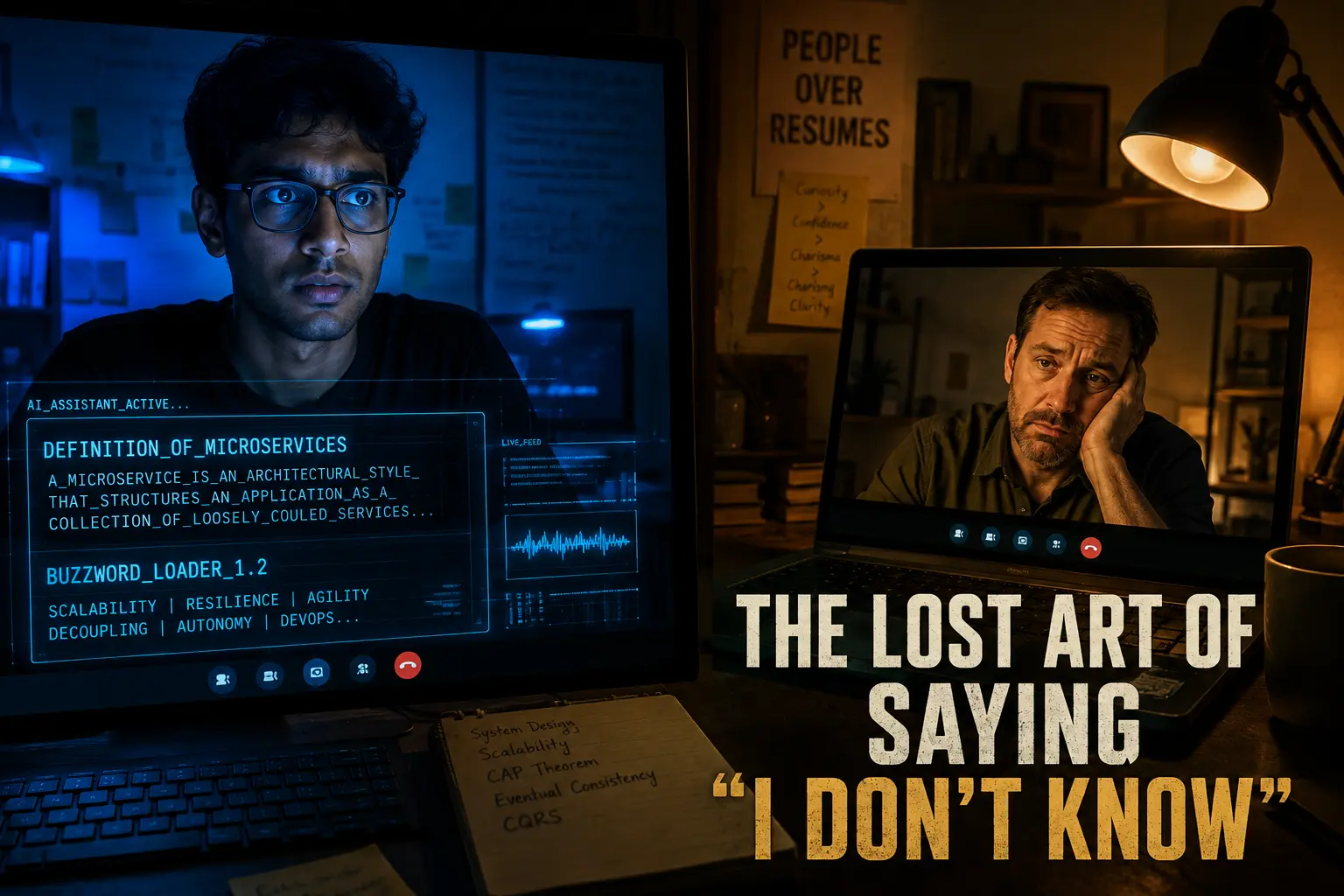
During remote interviews, the signs are quite obvious. I ask a technical question, there is an awkward surprise and drama of thinking, and then I watch the candidate’s eyes track left-to-right across their second monitor. They deliver a flawless, textbook definition packed with every industry buzzword imaginable, read in a flat, robotic tone.
But when I interrupt their monologue with a simple follow-up—"You just mentioned asynchronous processing, can you explain how you'd handle a failed job in that specific scenario?"—the illusion shatters. They don't understand the words they literally just spoke. They stutter, get defensive, and begin confidently blabbering nonsense just to keep talking. Sometimes, they will again start reading from their AI teleprompter, without even realising what they have been talking. The result is a far worse impression than if they had simply admitted they didn't know.
Saying "No" has become abnormal. Candidates have convinced themselves that silence is a fatal failure, completely missing the fact that reading off a screen and failing to explain yourself leaves a far worse, unredeemable impression.
Defeating the True Purpose of an Interview
If you are a candidate, you need to realize something fundamental: An interview is not just a test of your knowledge.
You have already proven your technical aptitude by passing university exams, clearing competitive screening rounds, or showcasing your resume. If I just wanted to see if you knew the definition of a database index, I could send you a multiple-choice quiz.
An interview is an entirely different arena. It is a human-to-human evaluation of:
- Character and Integrity: Can I trust you in a production environment?
- Coachability: How do you react when you hit the boundary of your current knowledge?
- Ambiguity Management: How do you reason through a problem when you don't have all the pieces?
If your only contribution is reading what an AI tells you to say, then the AI is providing the value—not you. The real interview isn't about having every answer; it's about demonstrating how you think, learn, communicate, and handle uncertainty. Those are the qualities that build trust, and they're the reason companies hire people instead of just deploying another AI agent.
A Concerning Trend for the New Generation
This epidemic is particularly alarming when it comes to fresh graduates and junior engineers entering the tech industry.
The early years of an engineering career are entirely about learning, and true learning cannot happen without embracing failure. When you treat yourself like an all-knowing encyclopedia, you close the door to growth. If you cannot accept the vulnerability of a knowledge gap during a 45-minute interview, how will you ask for help when a production database goes down? How will you admit a mistake to a client, or tell your team lead that a deadline is unrealistic?
By leaning on AI to mask their limitations, this new generation is missing out on crucial character-building moments. They are trading long-term professional resilience for short-term, easily detectable deception.
Honesty is the Ultimate Differentiator
The ultimate irony of the AI era is that while software is getting better at pretending to be human, human candidates are destroying their competitive edge by trying to act like software.
If you are currently preparing for interviews, close the extra tabs. Turn off the real-time AI assistants. Walk into the room with the confidence of what you do know, and the courage to admit what you don't.
When an interviewer throws a difficult question that catches you off guard, don't reach for a prompt. Take a breath, look them in the eye, and remember the lesson I learned as a sixteen-year-old trying to get into school. Your willingness to face a limitation with honesty is the one thing no algorithm can replicate.
Ultimately, we need to remember a fundamental truth in this new landscape: Answers are cheap. Character is expensive. In a world drowning in automated buzzwords, reclaiming the lost art of saying "I don't know" isn't a sign of weakness—it is the ultimate proof of integrity. The right interviewer won't remember that you knew every answer; they'll remember that they could trust you.